January 1999, Seattle
Wizards of the Coast was already the most powerful trading-card publisher on the planet; Magic: The Gathering had spent six years redefining what cardboard could do. So when Nintendo and Creatures Inc. needed a partner to bring the Pokémon Card Game to the West, Wizards was the only obvious answer. The deal closed in 1998. The set arrived in stores on January 9, 1999.
The Western launch was twenty-seven months behind Japan. By the time Base Set hit shelves, Media Factory had already printed four full expansions in Japanese, the franchise had a hit anime, and Pokémon Red and Blue had moved millions of Game Boy cartridges in North America. The cards arrived hot, and almost immediately ran out. Wizards reprinted Base Set continuously for over a year before moving on, which is why three distinct print runs of the same set exist: 1st Edition, Shadowless, and Unlimited.
By the time Team Rocket closed the Base Series eighteen months later in April 2000, the WotC operation had defined the design grammar that the entire vintage market still trades on: holographic rares, energy-symbol typography, the iconic yellow-bordered card frame. Everything that came after, in some sense, is a riff on what was decided in this stretch.
Five expansions in eighteen months
Six releases if you count the Black Star promo subset that ran continuously alongside main expansions. The mainline arc:
Base Set
The launch set. 1st Edition · Shadowless · Unlimited print runs.
Jungle
Generation 1 Pokémon not in Base Set. 1st Edition + Unlimited.
Fossil
Prehistoric Pokémon. 1st Edition + Unlimited.
Base Set 2
Reprint of Base + Jungle, Unlimited only.
Team Rocket
First "Dark" Pokémon. Introduces evil-themed mechanics.
WotC Promo (Black Star)
Tournament + magazine + movie promos through the WotC era.
The variants that decide the price
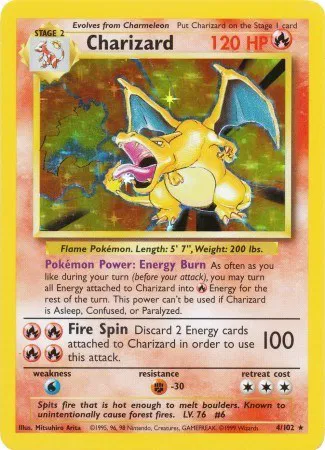
The single most important thing to understand about Base Series cards is that the same Charizard exists in three different print runs, and the price difference between them is roughly an order of magnitude. Reading the difference takes thirty seconds and is the foundational skill of vintage collecting.
1st Edition
The very first print of each set. Identifiable by the small "Edition 1" stamp printed under the bottom-left corner of the artwork frame. Wizards printed 1st Edition runs for Base Set, Jungle, Fossil, and Team Rocket; Base Set 2 was Unlimited only. 1st Edition holographic rares are the chase pulls of the era. PSA 10 1st Edition Charizard sells in the high six figures; PSA 10 1st Edition Blastoise and Venusaur are mid-five-figure cards.
Shadowless
Exclusive to Base Set. After the 1st Edition print run sold out, Wizards continued printing without the Edition 1 stamp but had not yet revised the artwork frame to add the drop shadow on the right edge of the central illustration window. The result is a "Shadowless" Unlimited print: same era, same paper stock, no stamp, no shadow. Shadowless Charizard PSA 10 is a five-figure card and the most accessible "early Charizard" if 1st Edition is out of reach.
Unlimited
The mass-market reprint that ran from late 1999 through 2000. Identifiable by the drop shadow on the right edge of the artwork frame and (on Base Set) the "©99, 2000 Wizards" copyright text. Unlimited holographic rares are the most common vintage chase cards in the secondary market. PSA 10 Charizard is a low-five-figure card, an order of magnitude below 1st Edition. Most "Pokémon card" childhood memories are Unlimited prints.
Iconic cards of the era
- Charizard 1st Edition Shadowless (Base Set 4/102)
- Blastoise 1st Edition (Base Set 2/102)
- Venusaur 1st Edition (Base Set 15/102)
- Dark Charizard (Team Rocket 4/82)
- Pikachu Red Cheeks (Base Set 58/102)
What the market is doing today
Base Series prices are bifurcated. PSA 10 1st Edition holographic rares (Charizard, Blastoise, Venusaur, the trainer-themed chase rares from Team Rocket) sit at the absolute top of the vintage market and trade in five-to-six-figure ranges that have been roughly flat-to-up since the 2021 collector boom. PSA 9 versions of the same cards are an order of magnitude cheaper but represent the most liquid investment-grade segment of vintage.
Shadowless cards have outperformed Unlimited materially since 2022 as collectors increasingly distinguish between the three print runs at the variant level rather than the set level. Sealed Unlimited Base Set booster boxes (heavily counterfeited) require recent provenance to trade at full sealed-box prices. The honest centre of gravity for Base Series collecting today is graded singles, not sealed product.
Tracking a Base Series collection on Karpfolio
Karpfolio is the only portfolio tracker built specifically around the realities of vintage. The Base Series gets the variant treatment it requires: 1st Edition, Shadowless, and Unlimited are tracked as distinct variants for every applicable card, with separate sales histories, separate Guide Prices, and separate population data. The same logic applies to grade: PSA 10 and PSA 9 are tracked as independent assets within a card.
Add a card by name or scan a slab. Karpfolio aggregates real completed sales from six sources (eBay, Fanatics PWCC, Goldin, Heritage Auctions, PriceCharting, TCGPlayer), filters out cleanings and outliers, and produces a single Guide Price you can act on. No estimates. No algorithms inventing data. Every dot on the chart is a transaction that actually happened.