October 20, 1996, Tokyo
Twenty-seven months before any Pokémon card existed in the West, Media Factory printed the very first Japanese Expansion Pack. The launch date was October 20, 1996, eight months after Pokémon Red and Green had quietly become the best-selling Game Boy game of the year. The TCG was Nintendo's hedge against the property fading; it became the engine that turned a game franchise into a global phenomenon.
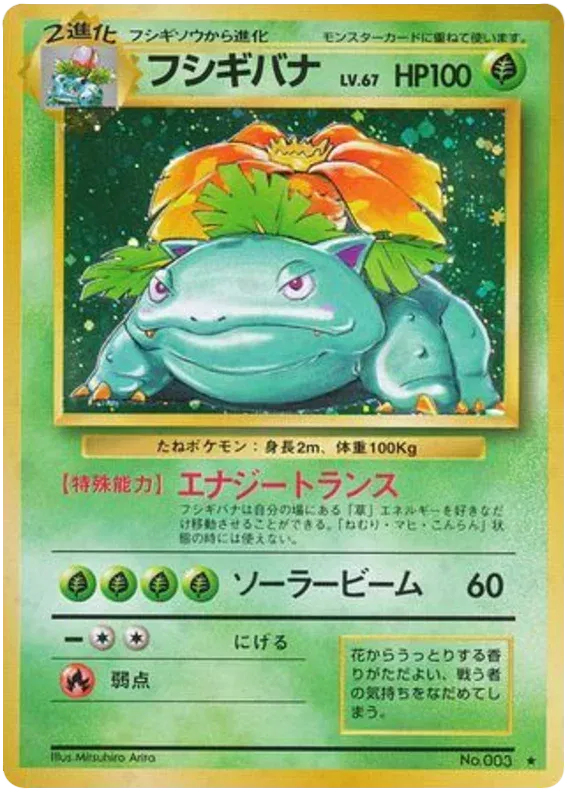
The launch set introduced 102 cards covering the original Charizard, Blastoise, Venusaur, and the foundational Energy and Trainer infrastructure. The artwork, almost entirely by Mitsuhiro Arita and Ken Sugimori, became the canonical visual identity of Pokémon for the next thirty years. Every reprint, every English translation, every modern Pokémon Center poster traces back to this print run.
Three more main expansions followed in thirteen months. By the time Rocket Gang closed the Original Series in November 1997, all 151 Pokémon had appeared on cardboard, a complete collection in just over a year, a pace that nothing since has matched.
The full set list
Four mainline Japanese expansions, all from Media Factory. Note that the Western "Base Set" launched in January 1999 is a translation and re-cut of the first three Japanese expansions, not a direct port of any single one.
Expansion Pack (拡張パック)
The very first Pokémon TCG release. October 20, 1996.
Pokémon Jungle
Gen 1 Pokémon not in the launch set.
Mystery of the Fossils
Prehistoric Pokémon. Maps to Western Fossil.
Rocket Gang
First Dark Pokémon. Maps to Western Team Rocket.
The No-Rarity print run
The very first print of the Japanese Expansion Pack omitted the rarity symbol that later prints carry in the bottom-right of the card frame. Subsequent prints added the standard ●, ◆, ★ symbols (common, uncommon, rare). Cards from the original print run, known as "No-Rarity" in the collector lexicon, are the earliest possible printing of every Pokémon in the entire game. They are the original artifact.
PSA 10 No-Rarity Charizard, Blastoise, and Venusaur are five-to-six-figure cards. The print run was small (the property was unproven and the initial commercial expectations modest), and surviving examples in gem mint condition are rare enough that the population is genuinely capped. For serious vintage collectors, No-Rarity is where Japanese vintage begins; every other Japanese print is, in some sense, a derivative.
Iconic cards of the era
- Pikachu Illustrator (CoroCoro 1998 promo, ~39 graded copies)
- No.1 Trainer (Tournament 1997, ~7 copies)
- No.2 Trainer / No.3 Trainer Trophy
- Charizard Holo Japanese Base Set (No-Rarity print)
- Blastoise No-Rarity (1996 first print run)
Pikachu Illustrator and the Trophy cards
The Original Series sits beside a small constellation of Japan-only promotional cards that command the highest prices in the entire trading card hobby. Pikachu Illustrator, the 1998 CoroCoro Comic illustration contest prize (with around thirty-nine known PSA-graded copies), sold for $5.275 million in 2022, the most ever paid for a TCG card. The No.1, No.2, and No.3 Trainer Trophy cards from 1997 have similar levels of structural scarcity, with population in the single digits for No.1.
These cards are not strictly "set" cards: they were never available in booster packs. But they belong to the era both chronologically and culturally, and they define the upper bound of what Japanese vintage can be worth.
What the market is doing today
Japanese vintage as a category has materially outperformed Western vintage since 2022. The reasons are structural: smaller print runs, growing crossover demand from Asian collectors with home-market preference, and gradual recognition by Western collectors that the Japanese cards are the original artifact rather than a niche curiosity. PSA 10 No-Rarity Charizard has roughly tripled in five years; the No.1 Trainer trophy card has set successive auction records.
The four mainline sets are individually accessible: non-holo commons and uncommons in PSA 9 are still sub-$100 cards, but the holographic chase rares in early prints (No-Rarity, then ★◆●) are increasingly out of reach for casual collectors.
Tracking a Japanese Original Series collection on Karpfolio
Karpfolio supports the rarity-symbol distinction at the variant level: No-Rarity, ●◆★, and any subsequent reprint runs are tracked separately for every applicable card. The 5-language interface includes native Japanese card names, and the set browser surfaces JP sets with the same depth as their English counterparts. For collectors building a Japanese vintage portfolio, Karpfolio is the only tracker that does not treat the JP market as an afterthought.