The last chapter of Wizards of the Coast
By late 2002, Wizards' Pokémon licence was running out. Nintendo and The Pokémon Company had been preparing to bring distribution in-house since the previous year. The e-Card era was, in effect, a closing statement: three Western expansions (Expedition, Aquapolis, Skyridge) condensing five Japanese sets, all designed around a piece of hardware almost no one would buy.
That hardware was the Nintendo e-Reader, a Game Boy Advance accessory that scanned dot-code strips printed along the bottom edge of every e-Card-era card. Scanning a card unlocked short animations, sound clips, or minigames, a cross-media experiment that briefly made physical cards interactive. The technology never reached critical mass and was discontinued shortly after, but the dot-code strips remain the defining visual signature of the era.
When Skyridge released in May 2003, Wizards' tenure ended. The Pokémon Company took over global distribution and the modern era began. The cards Wizards printed in those final eighteen months, particularly Skyridge, are now among the most expensive vintage Pokémon assets per card, driven by the lowest print runs of any WotC era.
The full set list
Three Western expansions and five Japanese ones. The Japanese sets ran from December 2001 to November 2002; the Western sets condensed and re-ordered the material between September 2002 and May 2003.
Expedition Base Set
Massive set. Resets to card 1/165. Crystal Type debut.
Aquapolis
Largest set of the era by card count. Crystal Charizard, Lugia, Kingdra, Ho-Oh.
Skyridge
Final WotC set. Lowest print run of the era; chase holos are six-figure cards.
Base Expansion Pack
Opens the Japanese e-Card era. Direct precursor to Expedition.
The Town on No Map
Maps onto Aquapolis cards.
The Wind from the Sea
Continues Aquapolis material.
Split Earth
Skyridge precursor.
Mysterious Mountains
Final Media Factory set in Japan.
No 1st Edition. Crystal Type instead.
The e-Card era is the first WotC era without 1st Edition printing. Expedition, Aquapolis, and Skyridge were Unlimited only: no edition stamps, no rarity hierarchy beyond holographic vs. non-holographic. The chase tier shifted to a different mechanic: Crystal Type Pokémon.
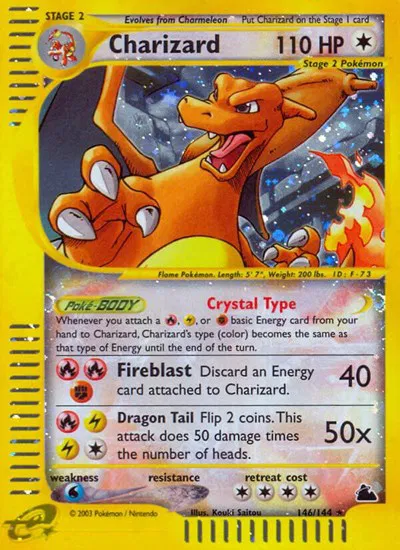
Crystal cards feature a transparent crystalline overlay across the central artwork, a unique foil treatment exclusive to Aquapolis and Skyridge. Five Crystal cards exist: Crystal Nidoking, Crystal Lugia, Crystal Ho-Oh (Aquapolis), Crystal Charizard, Crystal Celebi (Skyridge). Pull rates were extraordinarily low. PSA 10 Crystal Charizard from Skyridge is a five-to-six-figure card and the unambiguous flagship of the era.
Iconic cards of the era
- Crystal Charizard (Skyridge H29/H32)
- Crystal Lugia (Aquapolis H30/H32)
- Crystal Ho-Oh (Skyridge H31/H32)
- Crystal Nidoking (Aquapolis H17/H32)
- Skyridge holographic chase rares (whole H-numbered subset)
Skyridge: the rarest WotC set
Skyridge had the lowest print run of any WotC main set. Released in May 2003, just before The Pokémon Company assumed distribution, it produced for a market that had largely lost interest: the Pokémon craze of 1999–2001 had cooled and competing properties (Yu-Gi-Oh!, in particular) had captured the trading-card mindshare. Wizards printed conservatively. The result, twenty-three years later, is a set whose holographic chase rares are the most expensive cards-per-population in the WotC catalogue.
The H-numbered subset (H1–H32) is the chase set within Skyridge. Crystal Charizard (H29/H32) is the apex card. Other holographic rares from H1–H32 (particularly Charizard, Gyarados, Politoed, and Houndoom) frequently clear five figures in PSA 10.
What the market is doing today
The e-Card era has been the strongest performing segment of vintage since 2022. Crystal Type Pokémon, particularly Crystal Charizard PSA 10, have set successive auction records and remain the centre of investment-grade demand. Lower-population holographic rares from Skyridge are following a similar pattern: scarcity-driven appreciation as the broader Pokémon market normalises around print-run data rather than nostalgia.
Aquapolis is the under-loved middle of the era: a large set with more accessible chase rares, but materially cheaper than Skyridge despite similar Crystal coverage. For collectors building a complete e-Card portfolio, Aquapolis offers the most volume per dollar.
Tracking an e-Card Series collection on Karpfolio
Crystal Type cards are tracked as a distinct variant within their parent set, with their own sales history and Guide Price separate from the standard holographic rare. Karpfolio's variant taxonomy handles the e-Card era's specific quirks: H-numbered chase rares, regular holographic rares, Crystal cards, and the dot-code-bearing common cards each get their own classification. Sets covered: Expedition, Aquapolis, Skyridge in English; Base Expansion Pack, The Town on No Map, The Wind from the Sea, Split Earth, Mysterious Mountains in Japanese.