Generation 2 reaches the cards
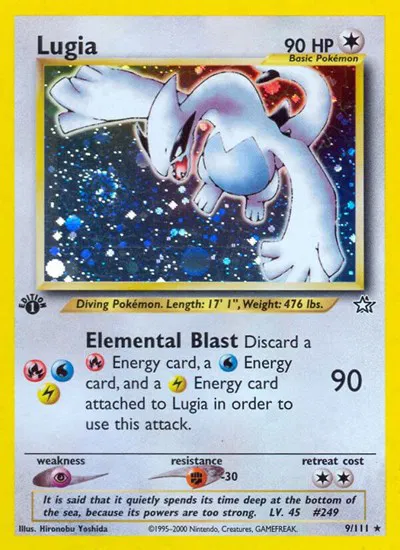
Pokémon Gold and Silver shipped to North American Game Boy Color in October 2000 and changed everything. One hundred new Pokémon, a day-night cycle, breeding, two new types: the franchise had a true sequel and the cardboard had to follow. Neo Genesis arrived in December 2000, two months after the games, and brought with it the most iconic holographic illustration of the entire vintage era: Lugia.
Japan moved first, as always. Neo Premium File released in December 1999, a teaser sub-set ahead of the main Neo Genesis equivalent ("Gold, Silver, to a New World..."), which followed in February 2000. Over the next two years, four main Japanese Neo expansions plus the VS and Web mini-sets explored every corner of Generation 2 territory. The Western release condensed those four mainline sets into Neo Genesis, Discovery, Revelation, and Destiny, and added Legendary Collection (May 2002) as a transition reprint that introduced the first reverse holos in TCG history.
The era introduced Darkness and Metal types, colour-coded badges that complicated deckbuilding and added a fundamentally new visual signal to the holographic frames. Shining Pokémon, the alt-colour foil treatment that debuted in Neo Revelation, became the chase mechanic of the era and remains one of the most coveted vintage subsets.
The full set list
Six Western releases (including Southern Islands and Legendary Collection), five mainline Japanese expansions, plus VS, Web, and the Neo Premium File teaser. The most expansive era in vintage Pokémon by raw card count.
Neo Genesis
First Gen 2 set. Lugia is the cover icon and a chase rare.
Neo Discovery
Unown forms, Pokégear, Espeon and Umbreon arrive.
Southern Islands
Special collector set, illustrations connect across cards.
Neo Revelation
First Shining Pokémon (alt-color holos). Shining Charizard + Shining Magikarp.
Neo Destiny
Closes the Neo arc. Light and Dark Pokémon both present.
Legendary Collection
Reprints of WotC classics. First-ever reverse holos in TCG history.
Neo Premium File
Japan-exclusive teaser set ahead of Neo Genesis.
Gold, Silver, to a New World...
Japanese Neo Genesis equivalent.
Crossing the Ruins...
Japanese Neo Discovery equivalent.
Awakening Legends
Japanese Neo Revelation equivalent. Shining Pokémon debut.
Darkness, and to Light...
Japanese Neo Destiny equivalent.
VS
Mini-set built around Trainer-vs-Trainer matches.
Web
Japan-only mini-set. Closes the Neo era.
The last era of 1st Edition
Neo Genesis, Discovery, Revelation, and Destiny all had 1st Edition print runs in English. Legendary Collection did not: Wizards discontinued the 1st Edition designation after Neo Destiny. This makes the chase rares of the four mainline Neo sets the final 1st Edition cards Pokémon ever printed in the West, a footnote that has materially shaped collector demand for fifteen years.
1st Edition Lugia (Neo Genesis 9/111) is the era's six-figure flagship; PSA 10 examples have cleared $30,000+ at auction multiple times. 1st Edition Espeon and Umbreon (Neo Discovery), the first appearances of Eevee's Generation 2 evolutions on cardboard, are similarly elevated. The "Grail" tier among Neo collectors is reasonably narrow: Lugia, Espeon, Umbreon, Ho-Oh (Neo Revelation), and the four Shining Pokémon.
Iconic cards of the era
- Lugia 1st Edition (Neo Genesis 9/111)
- Shining Charizard (Neo Destiny 107/105)
- Shining Magikarp (Neo Revelation 66/64)
- Espeon (Neo Discovery 1/75)
- Umbreon (Neo Discovery 13/75)
Shining Pokémon and Crystal Type's predecessor
Shining cards debuted in Neo Revelation: alt-colour holographic versions of specific Pokémon, printed at low pull rates and named "Shining [Pokémon]" rather than the standard species name. Shining Magikarp was the first; Shining Charizard arrived in Neo Destiny and immediately became the most desirable card of the era after Lugia. The Shining mechanic is the conceptual predecessor to Crystal Type Pokémon in the e-Card series: both treatments use a unique foil overlay rather than the standard holo-rare frame.
Six Shining cards exist across Neo Revelation and Neo Destiny: Magikarp, Gyarados, Charizard, Steelix, Tyranitar, Mewtwo. PSA 10 1st Edition examples sit in the high four-to-five-figure range collectively; Shining Charizard is the highest by a meaningful margin.
What the market is doing today
Neo Series sits in the second tier of vintage market depth, below Base Series flagship cards but above e-Card era Crystal types in absolute price points. The era benefits from broad Generation 2 nostalgia (Gold and Silver remains the most-loved era of the mainline games) and from the structural scarcity of 1st Edition prints in the largest set of the run.
Legendary Collection is its own micro-market. Reverse holos from this set were a printing experiment, and copies in PSA 10 are remarkably difficult to come by: the foil treatment was prone to chipping and centering issues. Reverse-holo Charizard PSA 10 from Legendary is a mid-four-figure card despite being a reprint.
Tracking a Neo Series collection on Karpfolio
Neo cards are tracked with three-axis variant segmentation: 1st Edition vs. Unlimited, the Shining-vs-standard distinction, and the holo-vs-non-holo split. Legendary Collection reverse holos are tracked as a fourth variant where applicable. Karpfolio's Guide Price algorithm treats each combination as an independent asset, so a 1st Edition Lugia PSA 10 has its own sales history and market valuation distinct from the Unlimited print, the PSA 9 grade, and the much rarer 1st Edition holographic reverse on the back of the card.