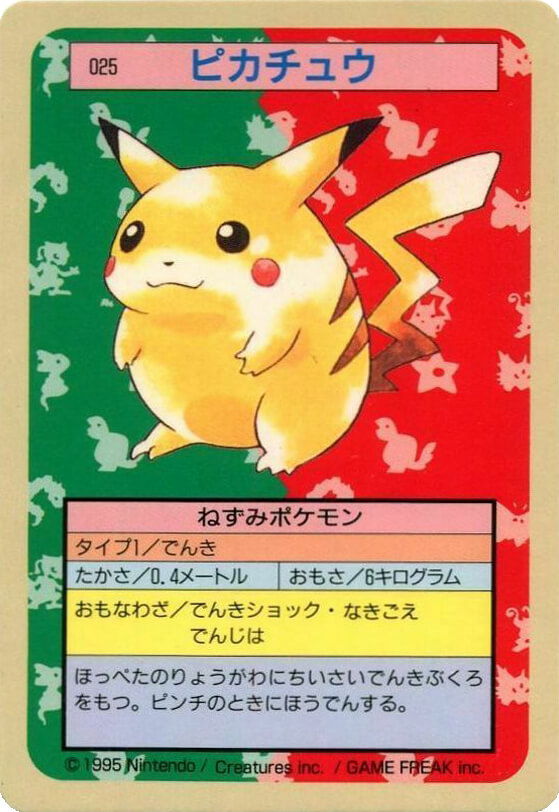
Before the game existed, the cards already did
Pokémon Red and Green released on the Game Boy on February 27, 1996. By March, Top-Sun was already printing gum-pack inserts featuring the original 151 Pokémon, paper collectibles bundled with chewing gum, sold at convenience stores across Japan. The Pokémon Card Game itself would not exist for another seven months. The Top-Sun cards are, by any reasonable definition, the very first commercially printed Pokémon cards.
They are not part of the Trading Card Game. They use the original Sugimori artwork from the Game Boy games rather than commissioned card art; they have no rules text, no HP, no Energy costs, no game function. They are pure collectibles, a paper memento of the franchise's earliest commercial moment, before anyone knew the property would become global.
Bandai's Carddass series followed in September 1996, the same month as the Game Boy game's mainland Japan launch. Carddass cards were sold via vending machines as small printed sheets that buyers separated by hand. Two main 1996 sets (Red and Green, mirroring the Game Boy versions) plus a 1997 follow-up brought every original Pokémon into the format. Together with Top-Sun, Carddass forms the entire pre-TCG canon.
The full pre-TCG list
Two formats, six releases. Top-Sun in two back-colour variants plus a holographic Prism subset. Carddass in three sequential sheet releases.
Top-Sun Blue Back
Released 1995, predates the TCG by a year. Blue card backs.
Top-Sun Green Back
Same series, green back variant.
Top-Sun Prism Holo
Holographic chase subset. Released later in the Top-Sun run.
Bandai Carddass Part 1 (Red)
Vending machine sheet collectibles. Released same month as Pokémon Red & Blue.
Bandai Carddass Part 2 (Green)
Companion to Carddass Red. Vending sheet format.
Bandai Carddass 1997
Final Carddass release covering all 151 Pokémon.
Top-Sun: blue back, green back, prism holo
Top-Sun cards exist in three variants: Blue Back (the most common), Green Back (slightly scarcer), and a 16-card Prism Holo subset released in 1997 as the chase tier. All three variants cover the same artwork, but the back-colour and the holographic foil treatment create three distinct collector pools.
PSA-graded survival rates are low. The cards were small (smaller than standard TCG cards), the gum left residue, and the print runs were modest. PSA 10 examples of high-profile Pokémon (Charizard, Blastoise, Venusaur, Mew, Mewtwo) clear four-figure prices in Blue Back and approach five figures in Green Back. The Prism Holo subset is the chase: Mew Prism Holo and Mewtwo Prism Holo are the era's flagship cards.
Iconic cards of the era
- Top-Sun Charizard Blue Back (1995)
- Top-Sun Holo Prism Mewtwo
- Carddass Red Charizard No.6
- Carddass Green Mew
- Top-Sun Mew (extremely scarce)
Carddass: vending machine collectibles
Bandai's Carddass machines dispensed small printed sheets containing four cards each. Buyers separated the cards by hand along perforated lines, a process that introduced edge irregularities that work against grading even today. Surviving examples in gem mint condition are scarcer than the print numbers alone would suggest, simply because separation damage was unavoidable for the average buyer.
The 1996 Red and Green sets cover 51 cards each. The 1997 follow-up extended coverage to 100 cards and overlaps significantly with the earlier releases. PSA 10 Carddass Charizard from the 1996 Red set is a four-to-five-figure card, meaningfully cheaper than No-Rarity TCG Charizard but commanding similar collector reverence as a "first commercial Pokémon card."
What the market is doing today
The pre-TCG segment is the smallest collector pool in vintage Pokémon and the most under-indexed by Western buyers. Top-Sun and Carddass cards regularly appear at sub-$100 in raw form on Japanese auction sites and command premiums of 5–20× when surfaced through Western marketplaces, a structural arbitrage that mature vintage collectors exploit consistently.
High-grade Top-Sun (PSA 9+) has materially outperformed mainline TCG vintage on a percentage basis since 2022, driven by population data finally being available (PSA only began grading these in volume around 2020) and by collector recognition that the cards genuinely predate the entire TCG. The ceiling is rising; the floor is rising faster.
Tracking pre-TCG collectibles on Karpfolio
Karpfolio handles Top-Sun and Carddass with first-class support: they get their own set browser entries, native variant tracking (Blue Back, Green Back, Prism Holo for Top-Sun; Red, Green, 1997 for Carddass), and Guide Prices computed from the same six aggregated sales sources used for mainline TCG. The pre-TCG era is where most vintage trackers fall over: cards that aren't technically TCG products often get filed under "miscellaneous." Karpfolio gives them their own home.