The set, in context
Jungle launched in North America on June 16, 1999, just over five months after the original Base Set. The expansion filled a structural gap: a meaningful chunk of the original 151 Pokémon never appeared in Base Set because the Western re-cut had to fit a single 102-card box. Jungle was the catch-up, focused on Pokémon associated with grass, jungle, and broadly "wild" environments — though the theme is loose enough that the set includes Snorlax, Wigglytuff, and the Eevee evolutions alongside grass-types.
The set has two print runs: 1st Edition (with the Edition 1 stamp under the artwork) and Unlimited (no stamp, larger run). Unlike Base Set, Jungle has no Shadowless variant — Wizards had standardized the drop-shadow frame by the Jungle print run. The Pikachu non-holo print also features a "no expedition badge" variant on the lower-left of the artwork (the so-called "missing Pokédex tab"), but unlike the Base Set Red Cheeks, the variation is subtle enough that it does not generate the same premium structure.
Wigglytuff 16/64 is the cover icon. The three Eeveelutions (Vaporeon 12/64, Jolteon 4/64, Flareon 3/64) are arguably the most collected Pokémon in Jungle, driving steady demand from collectors who prioritize creature popularity over card-rarity hierarchy. Jungle sits inside the broader Base Series alongside Base Set, Fossil, Team Rocket and Base Set 2.
Rarity breakdown
The three print runs
Reading the variant on a Base Set card takes thirty seconds and is the foundational skill of vintage Pokémon collecting. The price gap between print runs is roughly an order of magnitude per tier.
1st Edition
"Edition 1" stamp printed under the bottom-left corner of the artwork frame. Smaller print run, launch period only.
The first commercial print of Jungle, distinguishable by the Edition 1 stamp. Smaller graded population than Unlimited; PSA 10 1st Edition holos sit roughly an order of magnitude above Unlimited equivalents.
Unlimited
No "Edition 1" stamp. Drop shadow on the right edge of the central artwork frame is present (standard frame).
Mass-market reprint that ran from late 1999 through 2000. Most "Pokémon card from childhood" memories trace back to Unlimited Jungle prints. Still collectible, but at meaningfully lower price tiers than 1st Edition.
The chase cards
The cards that drive collector demand and define the secondary market for Jungle. PSA 10 examples of these are mid-five-figure to six-figure assets in their 1st Edition print runs.
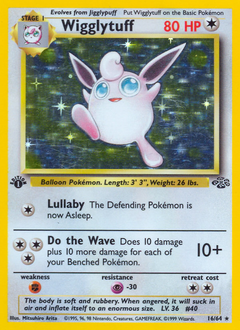
Wigglytuff
The cover icon of Jungle. PSA 10 1st Edition trades in the mid-five figures as of 2026, with the Unlimited version at roughly 10-15% of that price.
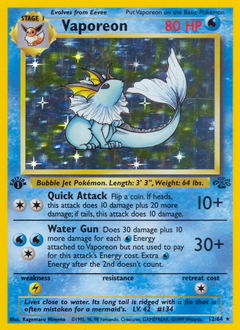
Vaporeon
The Water Eevee evolution. Strong demand from collectors targeting the original three Eeveelutions as a thematic mini-collection.
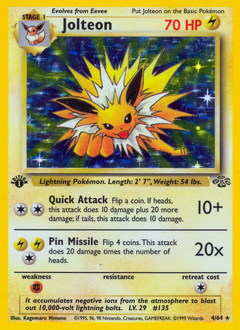
Jolteon
The Electric Eevee evolution. Co-flagship of the Eeveelution trio with persistent secondary-market demand.
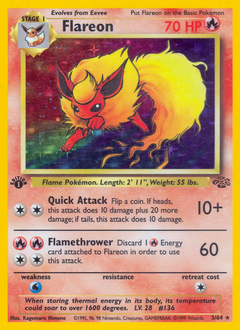
Flareon
The Fire Eevee evolution. Completes the original Eeveelution trio in Jungle; high-grade examples are scarcer than Vaporeon and Jolteon.
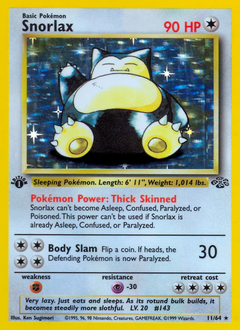
Snorlax
Iconic creature appearing in early Pokémon games and anime as a roadblock. PSA 10 1st Edition Snorlax has materially appreciated since 2022 driven by character demand.
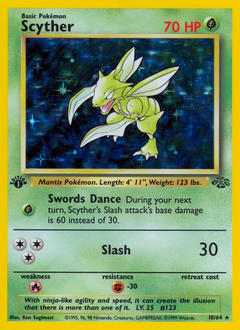
Scyther
Bug-type cult favorite. Steady mid-tier demand within the Jungle holo set.
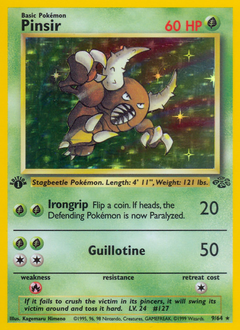
Pinsir
The other Bug-type holo in Jungle. Competes with Scyther for collector attention; both maintain similar PSA 10 valuations.
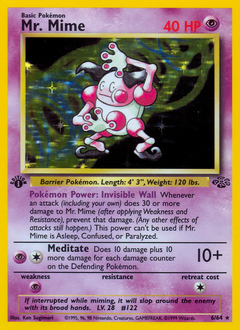
Mr. Mime
Psychic-type holo with a polarising design. Smaller graded population than the more popular cards keeps PSA 10 prices stable.
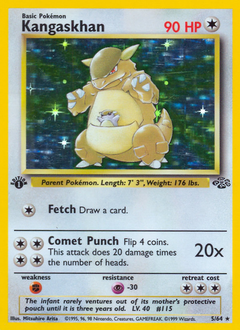
Kangaskhan
Normal-type holo, mid-tier collector demand. Often paired with the 1998 Trophy Kangaskhan promo as a thematic mini-collection.
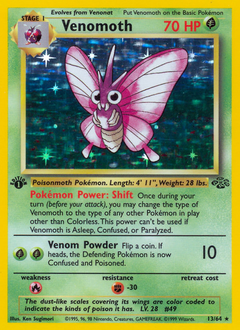
Venomoth
Lower-profile Bug/Poison-type holo. Among the most accessible PSA 10 starting points for a Jungle holo collection.
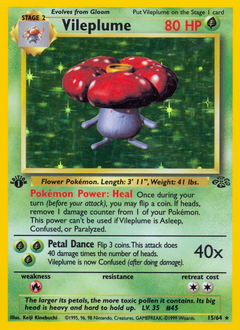
Vileplume
Grass-type Holo with strong ties to the anime Erika episode. Steady but not headline-grabbing market.
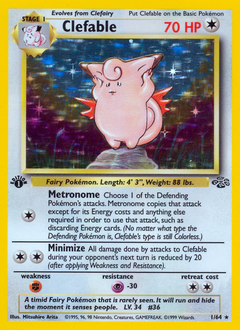
Clefable
The first card by number in Jungle. Fairy-adjacent design (pre-Fairy type) with a small but devoted collector base.
Where the market sits in 2026
Per Karpfolio's six-source sales aggregation through mid-2026, Jungle 1st Edition holographic rares trade at roughly half the price of equivalent Base Set 1st Edition cards. The structural difference is print run size: Wizards had ramped production by Jungle's release, so 1st Edition Jungle survived in larger graded population than 1st Edition Base Set. PSA 10 1st Edition Wigglytuff trades around the mid-five figures; the Eeveelution trio is in similar territory.
Unlimited Jungle is the most accessible WotC vintage segment for new graded vintage collectors. PSA 10 Unlimited holos start in the low four figures and scale up to mid-four figures for the most demanded cards (Wigglytuff, Vaporeon, Jolteon). For collectors building a complete WotC Base-era graded portfolio on a budget, Unlimited Jungle is the natural entry point.
PSA population data through 2026 shows Jungle as the most-graded WotC set after Base Set, reflecting both its larger original print run and the strength of collector demand. Jolteon and Vaporeon have the highest PSA 10 populations among Jungle holos — character popularity translates into more cards submitted for grading.
Tracking Jungle on Karpfolio
Karpfolio tracks Jungle with full variant awareness. 1st Edition and Unlimited prints have separate sales histories and per-PSA-grade Guide Prices computed from real completed sales across six aggregated sources (eBay, Fanatics PWCC, Goldin, Heritage Auctions, PriceCharting, TCGPlayer). The Eeveelution trio gets the per-grade treatment that serious collectors require for accurate portfolio valuation.