The set, in context
Wizards of the Coast launched the Pokémon Trading Card Game in North America on January 9, 1999, twenty-seven months after the Japanese original. Base Set was a translation and re-cut of the first Japanese expansion (Expansion Pack, October 1996) plus selected cards from Jungle and Fossil. The result was a single 102-card foundational expansion that introduced the original 151 mythology to a Western audience already obsessed with the Game Boy game.
The set sold out within months. Wizards reprinted it continuously through 2000, which is why three distinct print runs of the same 102 cards exist: 1st Edition (limited launch run), Shadowless (early Unlimited, no drop shadow on the artwork frame), and Unlimited (mass-market reprint). The price gap between these print runs is roughly an order of magnitude per tier, and reading the difference is the foundational skill of vintage Pokémon collecting.
Charizard 4/102 is the cover icon. A PSA 10 1st Edition Shadowless example sold for $420,000 at Goldin in 2022, a record that still stands as of 2026. The same card in Unlimited PSA 10 trades in the mid-four to low-five figures. Same artwork, same rarity stamp, different print run, an order of magnitude in value. Base Set sits inside the broader Base Series alongside Jungle, Fossil, Team Rocket and Base Set 2.
Rarity breakdown
The three print runs
Reading the variant on a Base Set card takes thirty seconds and is the foundational skill of vintage Pokémon collecting. The price gap between print runs is roughly an order of magnitude per tier.
1st Edition
"Edition 1" stamp printed under the bottom-left corner of the artwork frame. Smaller print run, launch period only.
The very first commercial print of Base Set. Production was limited; surviving graded population is the smallest of the three runs. PSA 10 1st Edition holographic rares sit at the top of the entire vintage market.
Shadowless
No "Edition 1" stamp AND no drop shadow on the right edge of the central artwork frame. Thinner HP text. "©99 Wizards" copyright line.
Early Unlimited print run produced after 1st Edition sold out but before Wizards revised the artwork frame. Same era and paper stock as 1st Edition, just without the rarity stamp. PSA 10 Shadowless holos are mid-five-figure cards.
Unlimited
Drop shadow on the right edge of the central artwork frame. "©99, 2000 Wizards" copyright line. Standard mass-market print.
The reprint that ran from late 1999 through 2000. Largest print run by far; most "Pokémon card from childhood" memories trace back to Unlimited prints. PSA 10 holos are still meaningful cards but an order of magnitude below 1st Edition.
The chase cards
The cards that drive collector demand and define the secondary market for Base Set. PSA 10 examples of these are mid-five-figure to six-figure assets in their 1st Edition print runs.
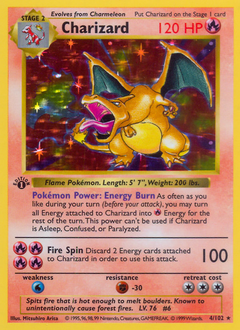
Charizard
The cover icon of the entire TCG. The Goldin record (PSA 10 1st Edition Shadowless, $420,000) was set in 2022 and still stands; mid-2026 comparables on PSA 10 1st Edition Shadowless trade in the $200-350K range. PSA 10 Unlimited: $14-22K. The single most recognizable trading card of the modern collectibles market.
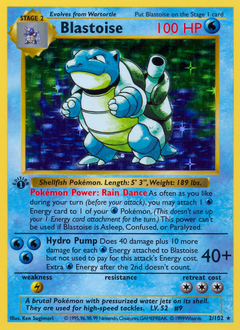
Blastoise
The Water-type starter and capstone of its evolution chain. PSA 10 1st Edition trades in the high five figures as of 2026. Co-flagship with Charizard and Venusaur as the original starter trio.
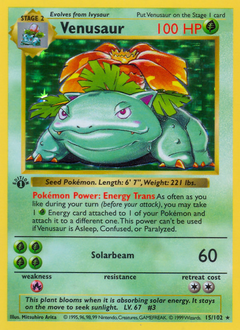
Venusaur
The Grass-type starter. Slightly less hyped than Charizard and Blastoise but priced commensurately. Completes the original starter holo trio.
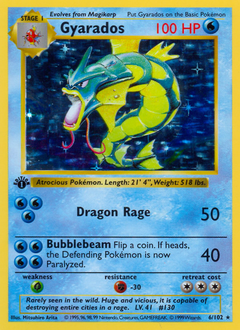
Gyarados
The Magikarp evolution. Karpfolio-relevant for obvious reasons. Strong PSA 10 demand driven by character popularity, particularly among graded vintage portfolios built around iconic creatures.
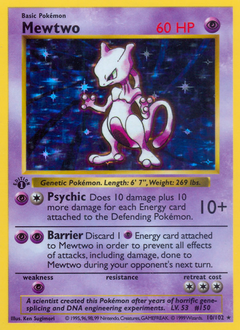
Mewtwo
Genetic Pokémon. Cover star of Pokémon: The First Movie (1998). Among the most-pulled-from-memory Holo Rares of the era.
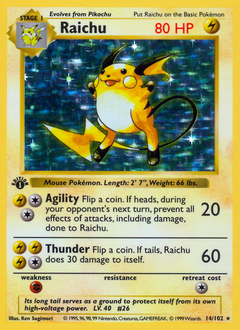
Raichu
Pikachu's evolution. Lower hype than starters but consistent collector demand. PSA 10 1st Edition runs in the mid-four figures in 2026.
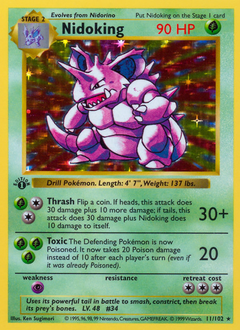
Nidoking
Genuinely scarce holographic rare with strong PSA 10 demand among completionists building the full 16-holo Base Set rainbow.
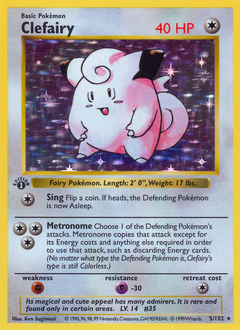
Clefairy
One of the original Holo Rares. Widely overlooked relative to starter cards, which is part of why high-grade examples remain accessible.
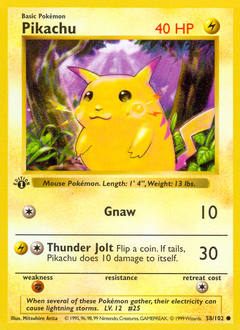
Pikachu (Red Cheeks)
The Yellow Cheeks vs Red Cheeks variant: 1st Edition and early Shadowless prints have red cheeks; later prints faded to yellow. Red Cheeks PSA 10 commands a premium for what is technically a common card.
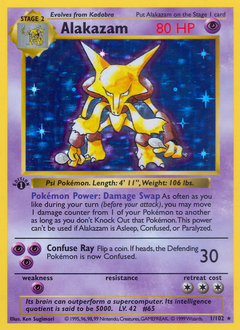
Alakazam
The first card by number. Holographic Pokémon Power introducing the mechanic that defined Base-era deck design.
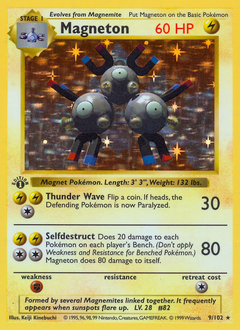
Magneton
Iconic Electric/Steel-adjacent design. Steady but not headline-grabbing market.
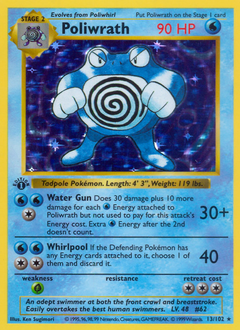
Poliwrath
Closing-tier holo rare; among the more accessible PSA 10 starting points for a Base Set holo collection.
Where the market sits in 2026
According to Karpfolio's aggregated sales data through mid-2026, PSA 10 1st Edition holographic rares sit at the absolute top of the vintage Pokémon market. The starter trio (Charizard, Blastoise, Venusaur), Mewtwo, and the Trainer-themed iconic cards have all set five-to-six-figure auction records since 2021 and continue trading at elevated levels through 2026 with low-volatility floors.
PSA 9 1st Edition holographic rares are the most liquid investment-grade segment of vintage. Pricing is meaningfully more accessible than PSA 10 (often 10-25% of equivalent PSA 10 values), the graded population is larger, and trading volume on eBay and Goldin is consistent through 2026. For collectors building a serious 1st Edition Base Set portfolio, PSA 9 is where most positions are taken.
Shadowless prints have outperformed Unlimited materially since 2022 as collectors increasingly distinguish between the three print runs at the variant level rather than the set level. Shadowless Charizard PSA 10 is the most accessible "early Charizard" if 1st Edition is structurally out of reach, with current 2026 comparables in the mid-five-figure range.
Sealed Unlimited Base Set booster boxes trade in the high four-to-low-five figures but require recent provenance: counterfeits exist and authentication-on-purchase is mandatory. Sealed 1st Edition booster boxes are seven-figure assets with a thin trading market. The honest centre of gravity for Base Set collecting in 2026 is graded singles, not sealed product.
Tracking Base Set on Karpfolio
Karpfolio tracks Base Set with full variant awareness. 1st Edition, Shadowless, and Unlimited are tracked as distinct assets for every applicable card, each with its own per-PSA-grade Guide Price computed from real completed sales across six aggregated sources (eBay, Fanatics PWCC, Goldin, Heritage Auctions, PriceCharting, TCGPlayer). The Pikachu Red Cheeks variant gets its own row. Trainer cards, Energies, and the rest of the 102-card set get the same per-grade treatment as the holo rares. No estimates, no algorithmic guesses, only transactions that actually happened.