The set, in context
Neo Destiny launched on February 28, 2002, five months after Neo Revelation. The expansion closed the Neo Series with the largest Neo set by card count (113) and introduced the Light Pokémon mechanic — Pokémon redeemed from corruption, mechanically distinct from their Dark counterparts. The thematic narrative paralleled Team Rocket's Dark Pokémon from Team Rocket two years earlier.
Most consequentially, Neo Destiny was the final 1st Edition print run in WotC history. Wizards discontinued 1st Edition stamping after Neo Destiny — Legendary Collection, Expedition, Aquapolis, and Skyridge are all Unlimited only. This makes Neo Destiny's 1st Edition holos the closing artifacts of the entire WotC 1st Edition era, a footnote that has materially shaped collector demand for fifteen years.
The chase tier is dominated by Shining Charizard 107/105 — alt-colour Charizard with full-card foil treatment, numbered above the official set count as a Secret Rare. PSA 10 1st Edition Shining Charizard is among the most expensive Neo-era cards, trading in the mid-to-high five figures. Shining Mewtwo 109/105 and Shining Tyranitar 108/105 complete the Neo Destiny Shining trio. The set sits inside the broader Neo Series as the closing fourth mainline expansion.
Rarity breakdown
The three print runs
Reading the variant on a Base Set card takes thirty seconds and is the foundational skill of vintage Pokémon collecting. The price gap between print runs is roughly an order of magnitude per tier.
1st Edition
"Edition 1" stamp printed under the bottom-left corner of the artwork frame. THE FINAL 1st Edition print run in WotC history.
The first and last commercial 1st Edition print of the WotC era. PSA 10 1st Edition Neo Destiny holos sit at premium levels driven by historical significance and small print run.
Unlimited
No "Edition 1" stamp. Standard drop-shadow artwork frame.
Mass-market reprint. The transition print run before Wizards moved to Unlimited-only for Legendary Collection and the e-Card era.
The chase cards
The cards that drive collector demand and define the secondary market for Neo Destiny. PSA 10 examples of these are mid-five-figure to six-figure assets in their 1st Edition print runs.
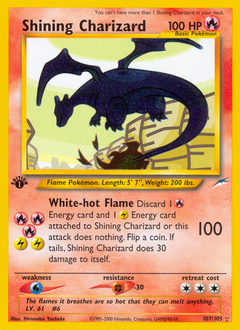
Shining Charizard
The most desirable Shining Pokémon. Alt-colour Charizard with full-card foil treatment. PSA 10 1st Edition Shining Charizard trades in the mid-to-high five figures as of 2026 — the most expensive non-Lugia Neo-era card and one of the most iconic Charizard variants in the entire vintage market.
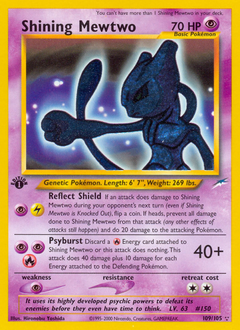
Shining Mewtwo
Alt-colour Mewtwo Secret Rare. Cross-set Mewtwo collectors (Base Set Mewtwo + Shining Mewtwo) drive parallel demand. PSA 10 1st Edition trades in the mid-five figures.
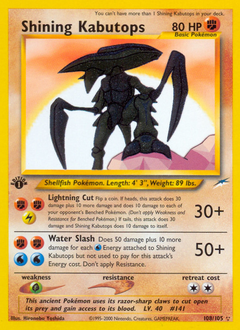
Shining Tyranitar
Alt-colour Tyranitar Secret Rare, completing the Neo Destiny Shining trio. PSA 10 1st Edition trades slightly below Shining Mewtwo, in the low-to-mid five figures.
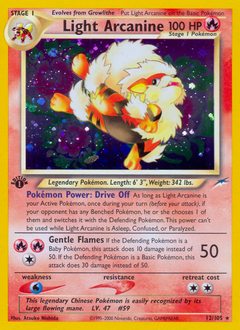
Light Dragonite
The Light counterpart to Fossil Dragonite. Cross-set Dragonite collectors target this alongside the Fossil version.
Dark Tyranitar
Dark Tyranitar in Holo Rare form. Cross-set Tyranitar collectors target the Neo Discovery, Neo Destiny Dark, and Shining Tyranitar variants.
Light Azumarill
Light Azumarill, alternative form to Neo Genesis Azumarill. Mid-tier holo with completionist demand.
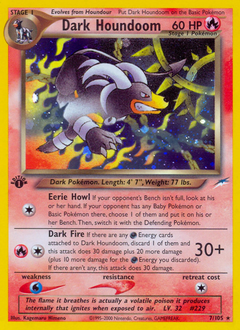
Dark Houndoom
Dark Houndoom, paired with Neo Discovery Houndoom as a thematic Dark-side mini-collection.
Light Dragonair
Light Dragonair Holo. Strong collector demand for the design quality and the Light/Dark Dragonair-Dragonite chain.
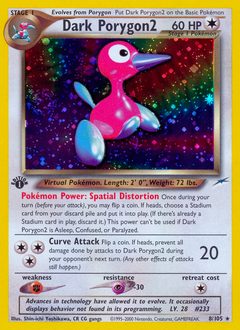
Light Dragonair (alt)
Alternative-art Light Dragonair Holo. Cross-art collectors target both Dragonair variants.
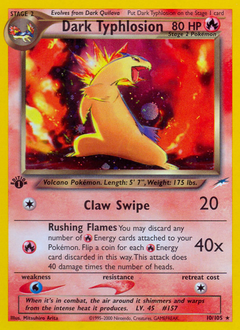
Light Flareon
Light Flareon, redeemed counterpart. Cross-set Flareon collectors (Jungle Flareon + Light Flareon) drive parallel demand.
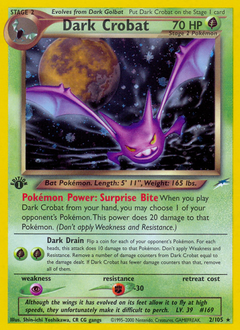
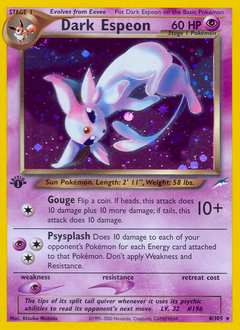
Dark Espeon
Dark Espeon, the corrupted Eeveelution. Cross-set Espeon collectors target this alongside Neo Discovery Espeon.
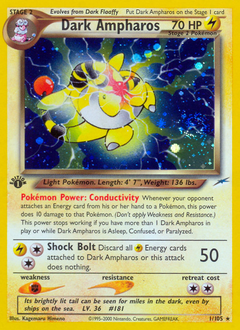
Dark Ampharos
The first card by number in Neo Destiny. Dark Ampharos, paired with Neo Genesis Ampharos as a thematic dual collection.
Where the market sits in 2026
Per Karpfolio's six-source sales aggregation through mid-2026, Neo Destiny is the most expensive Neo Series set on a per-card-population basis. The driver is dual: it is the final 1st Edition print run in WotC history (smaller graded population than other Neo sets) and it contains the most desirable Shining Pokémon (Shining Charizard).
PSA 10 1st Edition Shining Charizard 107/105 trades in the mid-to-high five figures and has appreciated meaningfully since 2022. The card sits at the intersection of three collector archetypes: Charizard collectors, Shining Pokémon collectors, and Neo Series collectors. All three drive parallel demand on the same asset.
Light and Dark Pokémon Holos trade at relatively uniform value tiers in the mid-four to low-five-figure range for PSA 10 1st Edition. The Light/Dark thematic pairing (Light Flareon + Dark Houndoom + Light Dragonair + Dark Espeon, etc.) is a coherent collector narrative that has supported steady appreciation.
Tracking Neo Destiny on Karpfolio
Karpfolio tracks Neo Destiny with full variant awareness, including the three Shining Pokémon as their own asset class distinct from standard Holo Rares. 1st Edition and Unlimited prints have separate sales histories and per-PSA-grade Guide Prices. The Light/Dark thematic pairing surfaces as a mini-collection within the broader Neo Series portfolio view.