The set, in context
Legendary Collection launched on May 24, 2002, three months after Neo Destiny closed the mainline Neo Series. The set occupied a unique transition position: it reprinted classic cards from Base Set, Jungle, Fossil, and Team Rocket, but introduced a structural innovation that defined every TCG set after: reverse holos.
For the first time in TCG history, every common, uncommon, and rare in Legendary Collection had a parallel reverse holographic version — same card, same artwork, but with the foil treatment applied to the card frame and background rather than the central illustration. The mechanic became standard for every Pokémon set printed after Legendary Collection. Reverse holos are now a baseline expectation in modern Pokémon TCG; they began here.
Only one print run: Unlimited. Wizards had discontinued 1st Edition stamping after Neo Destiny. Legendary Collection had no 1st Edition; the entire production was Unlimited from launch. The chase tier is the reverse holo subset of the original Base Series icons: reverse holo Charizard, Blastoise, Venusaur, Mewtwo. PSA 10 reverse holo Charizard is a mid-four-figure card despite being a reprint, driven by the structural scarcity of high-grade reverse holo prints (the foil treatment was prone to chipping). Legendary Collection sits at the boundary of the Neo Series and the e-Card era.
Rarity breakdown
The three print runs
Reading the variant on a Base Set card takes thirty seconds and is the foundational skill of vintage Pokémon collecting. The price gap between print runs is roughly an order of magnitude per tier.
Holo Rare
Standard holographic foil treatment on the central artwork. Same as classic Base-era holos.
The standard reprint format. Same artwork as the original Base Series holos but with the Legendary Collection set symbol and updated copyright. PSA 10 Holo Rare Legendary Collection cards trade at meaningful premium over Unlimited Base Series equivalents due to smaller print run.
Reverse Holo
Foil treatment applied to the card frame and background rather than the central artwork. Innovative for 2002.
The first-ever reverse holographic parallels in TCG history. Every common, uncommon, and rare in the set has a reverse holo version. PSA 10 reverse holos are scarce due to chipping issues during printing; mid-four-figure prices for chase reverse holos (Charizard, Blastoise, Venusaur).
Non-Holo Rare
Standard non-foil rare cards. No special treatment.
Reprint of classic Base-era rares without holographic treatment. The most accessible Legendary Collection variant tier.
The chase cards
The cards that drive collector demand and define the secondary market for Legendary Collection. PSA 10 examples of these are mid-five-figure to six-figure assets in their 1st Edition print runs.
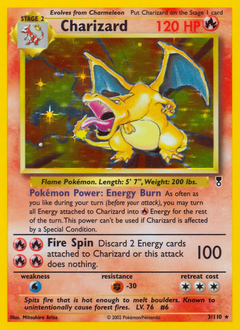
Charizard (reverse holo)
Reverse holographic Charizard. PSA 10 reverse holo Charizard is a mid-four-figure card driven by structural scarcity (the foil treatment was prone to chipping). The most desirable Legendary Collection card.
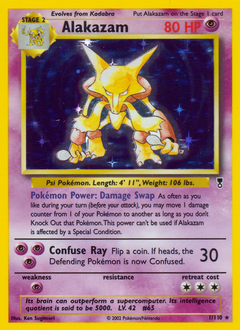
Alakazam
Reprint of Base Set Alakazam. Standard Holo Rare. Cross-set Alakazam collectors target this alongside the Base Set version.
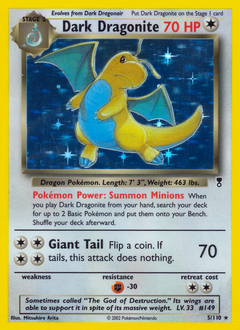
Dragonite
Reprint of Fossil Dragonite. Strong cross-set Dragonite collector demand alongside Fossil and Neo Destiny variants.
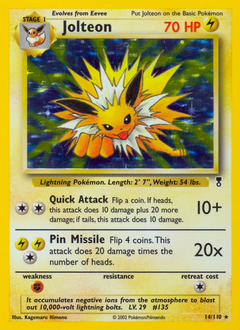
Mewtwo
Reprint of Base Set Mewtwo. Reverse holo Mewtwo from Legendary Collection is a particularly desirable variant for cross-set Mewtwo collectors.
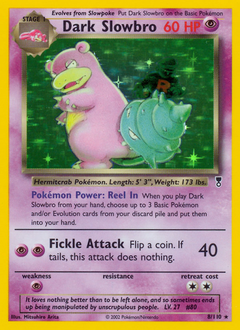
Hitmonchan
Reprint of Base Set Hitmonchan. Mid-tier holo with steady reprint-collector demand.
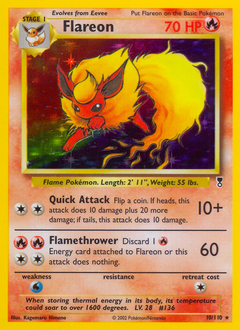
Magneton
Reprint of Base Set Magneton. Cross-set Magneton collectors target this alongside Base Set, Fossil, and Neo Revelation variants.
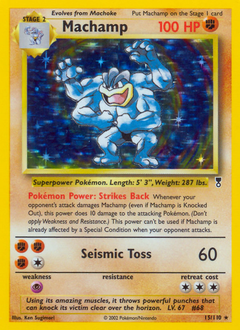
Nidoking
Reprint of Base Set Nidoking. Lower-profile reprint with completionist demand.
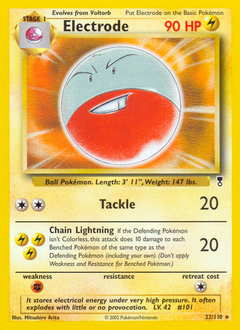
Aerodactyl
Reprint of Fossil Aerodactyl. Cross-set Aerodactyl collectors target this alongside the original Fossil version.
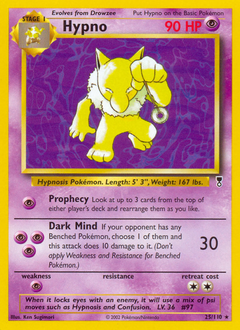
Gengar
Reprint of Fossil Gengar. Strong cross-set Gengar collector demand alongside Fossil and Gym Challenge Sabrina's Gengar.
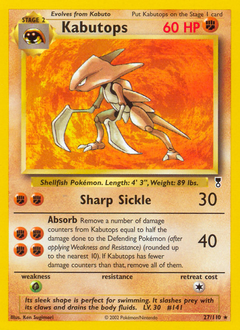
Lapras
Reprint of Fossil Lapras. Mid-tier Holo with steady demand.
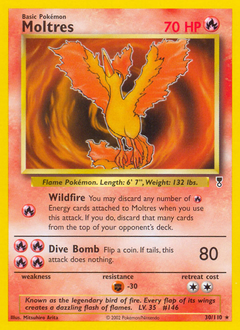
Articuno
Reprint of Fossil Articuno. Cross-set Legendary Bird collectors target this alongside Fossil Articuno, Moltres, Zapdos.
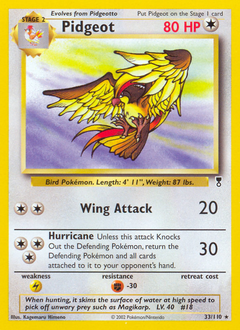
Wigglytuff
Reprint of Jungle Wigglytuff. Cross-set Wigglytuff collectors target this alongside the original Jungle version.
Where the market sits in 2026
According to Karpfolio's aggregated sales data through mid-2026, Legendary Collection occupies a peculiar market niche. The non-reverse-holo cards trade at modest premium over Unlimited Base Series equivalents (~10-30% above), reflecting the smaller print run. The reverse holos trade at materially higher premiums (~5-10× the standard Holo Rare price) due to PSA 10 grading scarcity.
Reverse holo Charizard is the chase. PSA 10 examples are mid-four-figure cards driven by the foil chipping issue during printing — many copies that surfaced have grade-limiting whitening on the foil edges. Reverse holo Blastoise, Venusaur, and Mewtwo follow in the low-to-mid four-figure range.
Legendary Collection booster boxes are increasingly difficult to source sealed and trade at premiums over Unlimited Base Series boxes. The set's structural innovation (reverse holos) has become foundational to modern Pokémon TCG, which has supported retrospective collector interest in Legendary Collection as the originator of the mechanic.
Tracking Legendary Collection on Karpfolio
Karpfolio tracks Legendary Collection with full variant awareness, including the reverse holo parallels as a distinct asset class from standard Holo Rares. Each variant (Holo Rare, Reverse Holo, Non-Holo Rare) has its own per-PSA-grade Guide Price computed from real completed sales across six aggregated sources. Cross-set reprint relationships (Charizard across Base Set, Legendary Collection, etc.) get the parallel data view that serious cross-set collectors require.