The set, in context
Expedition Base Set launched on September 15, 2002, four months after Legendary Collection closed the Neo era reprint cycle. The expansion opened the e-Card Series and introduced two structural innovations: a dot-code strip printed along the bottom edge of every card (scannable with the Nintendo e-Reader Game Boy Advance accessory to unlock animations and minigames), and a complete restart of the card numbering convention — Expedition Base Set is numbered 1-165, resetting from the 110-card Legendary Collection cap.
The set is the largest mainline WotC set by card count (165 cards) and reprinted classic Generation 1 Pokémon (Charizard, Blastoise, Venusaur, Mewtwo) as Holo Rares with new artwork. Unlike Legendary Collection, Expedition's reprints are not "Base Set with new set symbol" — they are genuinely new card designs with new attacks, new HP totals, and new artwork commissioned for the e-Card era.
Only Unlimited print run — Wizards had discontinued 1st Edition stamping after Neo Destiny. The chase tier is concentrated in the standard Holo Rare set (no Crystal cards in Expedition; those debut in Aquapolis). The set sits inside the broader e-Card Series as the first of three mainline expansions before the WotC era closed with Skyridge.
Rarity breakdown
The three print runs
Reading the variant on a Base Set card takes thirty seconds and is the foundational skill of vintage Pokémon collecting. The price gap between print runs is roughly an order of magnitude per tier.
Unlimited
No edition stamp (entire e-Card era is Unlimited only). Dot-code strip along the bottom edge of every card.
The only print run of Expedition. Despite "Unlimited" labelling, the actual print run was meaningfully smaller than Base Series Unlimited prints — by 2002 the Pokémon TCG market had cooled significantly.
Reverse Holo
Foil treatment applied to the card frame and background rather than central artwork. Continues the Legendary Collection mechanic.
Every common, uncommon, and rare has a reverse holo parallel, continuing the mechanic introduced in Legendary Collection. PSA 10 reverse holos are scarce due to the same chipping issues that affected Legendary Collection prints.
The chase cards
The cards that drive collector demand and define the secondary market for Expedition. PSA 10 examples of these are mid-five-figure to six-figure assets in their 1st Edition print runs.
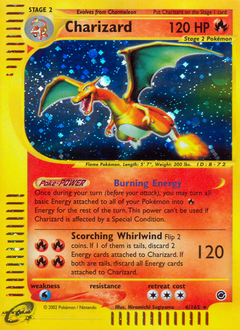
Charizard
Charizard reprinted with new e-Card-era artwork and attacks. Distinct collector item from Base Set Charizard. PSA 10 trades in the mid-four figures as of 2026, with reverse holo variants commanding meaningfully higher premium.
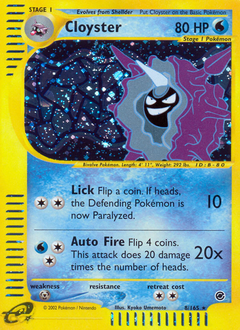
Crobat
Generation 2 Crobat reprint with e-Card-era artwork. Lower-profile holo with stable mid-tier demand.
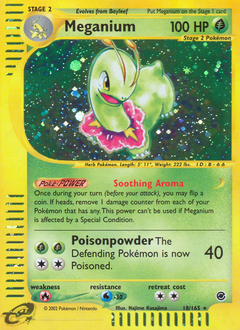
Hypno
Generation 1 Psychic-type Holo. Mid-tier collector demand within the Expedition hierarchy.
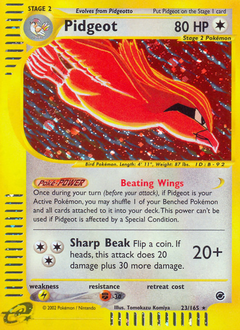
Magcargo
Generation 2 Fire/Rock-type Holo. Lower demand within Expedition but stable collector base.
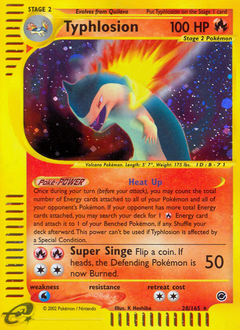
Pidgeot
Generation 1 Flying-type Holo. Cross-set Pidgeot collectors target this alongside Jungle Pidgeot variants.
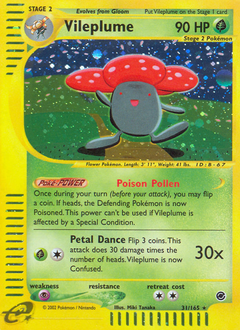
Slowking
Reprint of Neo Discovery Slowking with e-Card-era artwork. Cross-set Slowking variant collectors target both versions.
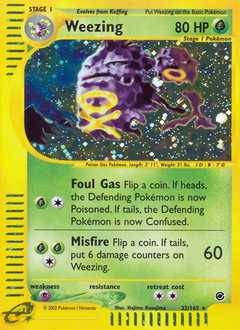
Snorlax
Snorlax reprinted with e-Card-era artwork. Cross-set Snorlax collectors (Jungle Snorlax + Rocket's Snorlax + Expedition Snorlax) drive parallel demand.
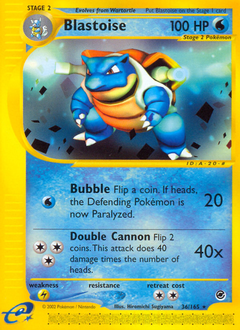
Tauros
Generation 1 Normal-type Holo. Lower-profile reprint with completionist demand.
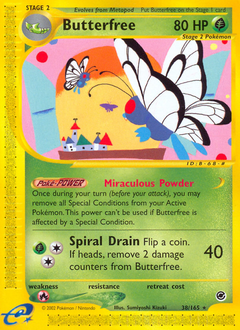
Venusaur
Venusaur reprinted with e-Card-era artwork. Distinct collector item from Base Set Venusaur. Cross-set starter trio collectors target this alongside Expedition Charizard.
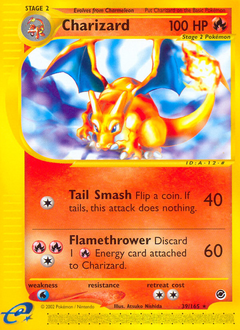
Vileplume
Reprint of Jungle Vileplume with e-Card-era artwork. Cross-set Vileplume collectors target both versions.
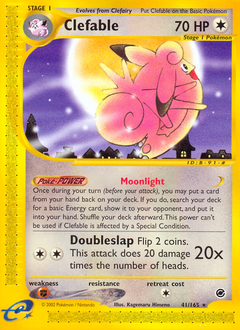
Xatu
Generation 2 Psychic/Flying-type Holo. Mid-tier demand within Expedition hierarchy.
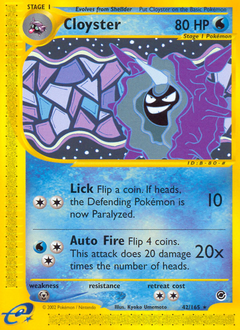
Zapdos
Reprint of Fossil Zapdos with e-Card-era artwork. Cross-set Legendary Bird collectors target this alongside Fossil Zapdos and Rocket's Zapdos.
Where the market sits in 2026
Karpfolio's database through mid-2026 indicates Expedition is the most accessible e-Card era segment for new graded vintage collectors. PSA 10 Holo Rares trade in the mid-four figures, materially below Skyridge equivalents but with similar collector appeal due to the e-Card era novelty (dot-code strips, new artwork).
Expedition reverse holos are the structural arbitrage opportunity within the set. PSA 10 reverse holo Charizard, Venusaur, and other chase cards trade at 3-5× the standard Holo Rare price due to grading scarcity. Many Expedition reverse holos in the population are PSA 9 or below due to the foil chipping issue inherited from Legendary Collection.
Sealed Expedition booster boxes are a niche collector segment. Print runs were larger than Skyridge but smaller than typical Base-era boxes. PSA-graded singles offer better liquidity and clearer per-card market data than sealed product.
Tracking Expedition on Karpfolio
Karpfolio tracks Expedition with full variant awareness. Holo Rare and reverse holo parallels are tracked as distinct asset classes, each with its own per-PSA-grade Guide Price. Cross-set reprint relationships (Expedition Charizard vs Base Set Charizard) surface in the broader portfolio view.