The set, in context
Skyridge released on May 12, 2003, the final Wizards of the Coast Pokémon set before The Pokémon Company assumed global distribution. By that point Wizards' interest in the property had waned: the Pokémon craze of 1999-2001 had cooled, Yu-Gi-Oh! had captured the trading-card mindshare among kids, and the company knew its licence was ending. Wizards printed Skyridge conservatively. The result, twenty-three years later, is the smallest WotC print run on record and the highest cards-per-population pricing in the Wizards catalogue.
Two structural elements drive Skyridge's collector appeal. First, the H-numbered chase set (H1-H32) — 32 holographic rares with their own number range, parallel to but separate from the main 144-card set. Second, Crystal Type Pokémon, a unique foil treatment introduced in Aquapolis and continued in Skyridge with three Crystal cards (Charizard, Celebi, plus one secret). Crystal Charizard 146/144 is the unambiguous flagship of the entire e-Card era.
No 1st Edition, no Shadowless, no print-run variants — Skyridge was Unlimited only. Wizards had discontinued 1st Edition stamping after Neo Destiny in February 2002. Skyridge sits inside the broader e-Card Series alongside Expedition and Aquapolis as the closing chapter of the WotC tenure.
Rarity breakdown
The three print runs
Reading the variant on a Base Set card takes thirty seconds and is the foundational skill of vintage Pokémon collecting. The price gap between print runs is roughly an order of magnitude per tier.
Unlimited
No edition stamp (the e-Card era has no 1st Edition prints). All Skyridge cards are Unlimited-only.
The only print run of Skyridge. Despite being labelled "Unlimited", the actual print run was the smallest of any Wizards-era main set, materially smaller than even Base Set 1st Edition. This produces unusually high per-card scarcity.
H-numbered Chase (H1-H32)
Card number prefixed with "H" (e.g. H6, H29). Always holographic.
Parallel chase set within Skyridge, sold at lower pull rates than standard holographic rares. The H-numbered subset is the primary collector focus of the set.
Crystal Type
Transparent crystalline overlay across the central artwork. Numbered above the official set count (e.g. 146/144).
Three Crystal cards exist in Skyridge, each with the unique transparent foil treatment. Lowest pull rate in the set; PSA 10 Crystal Charizard is the apex card of the entire e-Card era.
The chase cards
The cards that drive collector demand and define the secondary market for Skyridge. PSA 10 examples of these are mid-five-figure to six-figure assets in their 1st Edition print runs.
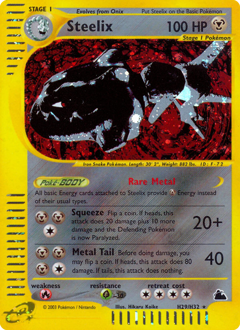
Crystal Nidoking
Crystal Type Nidoking from Skyridge. PSA 10 trades at high four to low five figures as of 2026. The H29 designation places it within the H-numbered chase set with Crystal foil treatment.
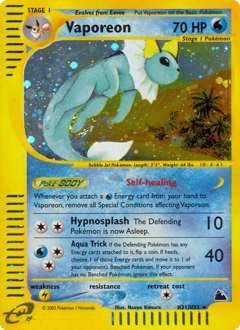
Crystal Ho-Oh
Crystal Type Ho-Oh, one of the era's most desirable Crystals after Charizard. PSA 10 trades at mid-four to low five figures through 2026.
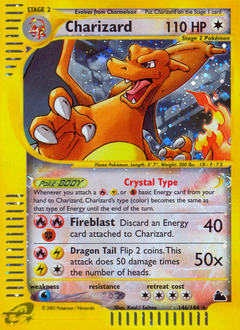
Crystal Charizard
The flagship of the entire e-Card era. PSA 10 Crystal Charizard 146/144 has cleared $100,000+ at auction multiple times since 2021 and continues trading in the high five to low six figures through 2026. The single most expensive non-1st-Edition WotC card.
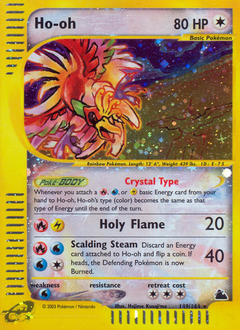
Crystal Celebi
The companion Crystal Secret Rare to Crystal Charizard. Lower demand than Charizard but materially scarcer; PSA 10 Crystal Celebi is a five-figure card.
Charizard
Standard (non-Crystal) Skyridge Charizard from the H-numbered chase set. PSA 10 trades in the mid-four figures, the most accessible Skyridge Charizard variant.
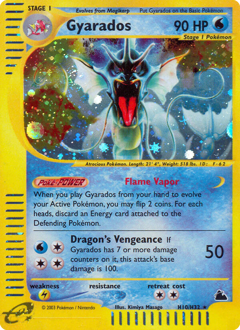
Gyarados
Karpfolio-relevant for obvious reasons. H-numbered Gyarados from Skyridge. Strong PSA 10 demand from collectors targeting iconic creatures across vintage eras.
Crystal Kabutops
The third Crystal Type Pokémon in the H-numbered range alongside Crystal Nidoking (H29) and Crystal Ho-Oh (H31). Rarest of the three by PSA 10 population.
Pichu
Baby Electric Pokémon, Generation 2 evolution branch. Surprisingly strong collector demand within Skyridge driven by character popularity.
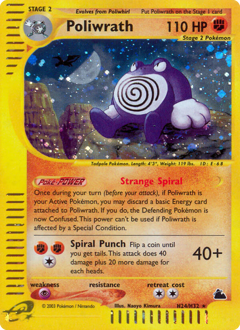
Scizor
Bug/Steel-type evolution of Scyther. H-numbered Holo with consistent collector demand.
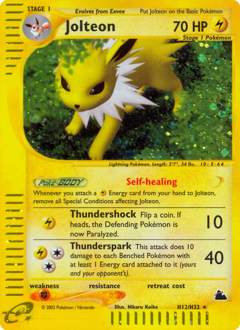
Hitmontop
Fighting-type Generation 2 Pokémon. Mid-tier H-numbered Holo with mostly completist demand.
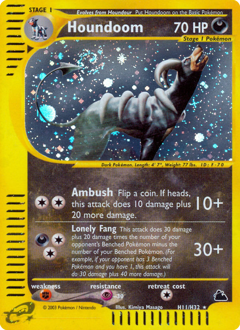
Espeon
Psychic Eeveelution. Strong demand from cross-set Eeveelution collectors who also target Jungle holo Eeveelutions and Neo Discovery prints.
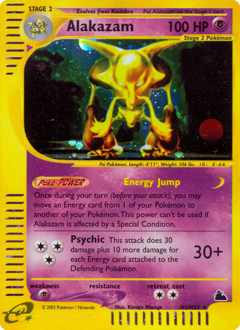
Aggron
The first card in the H-numbered chase set. Generation 3 Steel/Rock-type Pokémon — Skyridge included select Gen 3 Pokémon despite predating the official Gen 3 TCG era.
Where the market sits in 2026
Karpfolio's tracking through mid-2026 shows Skyridge as the strongest-performing WotC vintage segment on a percentage basis. Crystal Charizard 146/144 PSA 10 has set successive auction records and continues trading in the high five to low six figures, an order of magnitude above any non-1st-Edition Base-era card. The driver is structural: the smallest WotC print run combined with the most desirable foil treatment in the era.
The H-numbered chase set (H1-H32) trades at premium levels relative to equivalent main-set holographic rares. PSA 10 H-numbered cards typically clear mid-four to low-five figures depending on character popularity and PSA population. Crystal cards (H29, H31, H32 plus the Crystal secret rares 146/149) sit at the top of the H-set hierarchy.
Sealed Skyridge booster boxes are seven-figure assets with a thin trading market. Loose graded singles are the practical investment vehicle for Skyridge exposure, with PSA 10 H-numbered cards offering the best balance of liquidity and structural scarcity.
Tracking Skyridge on Karpfolio
Karpfolio tracks Skyridge with the variant taxonomy the e-Card era requires. H-numbered chase rares, Crystal Type Pokémon, secret rares, and main-set cards each get their own classification. The Crystal foil treatment is tracked as a separate variant from the standard Holo Rare frame, so a Crystal Charizard sales history is distinct from Skyridge H6 standard Charizard.